The aim of this magazine is to connect the communities of Hindu Kush, Himalaya, Karakorum and Pamir by providing them a common accessible platform for production and dissemination of knowledge.


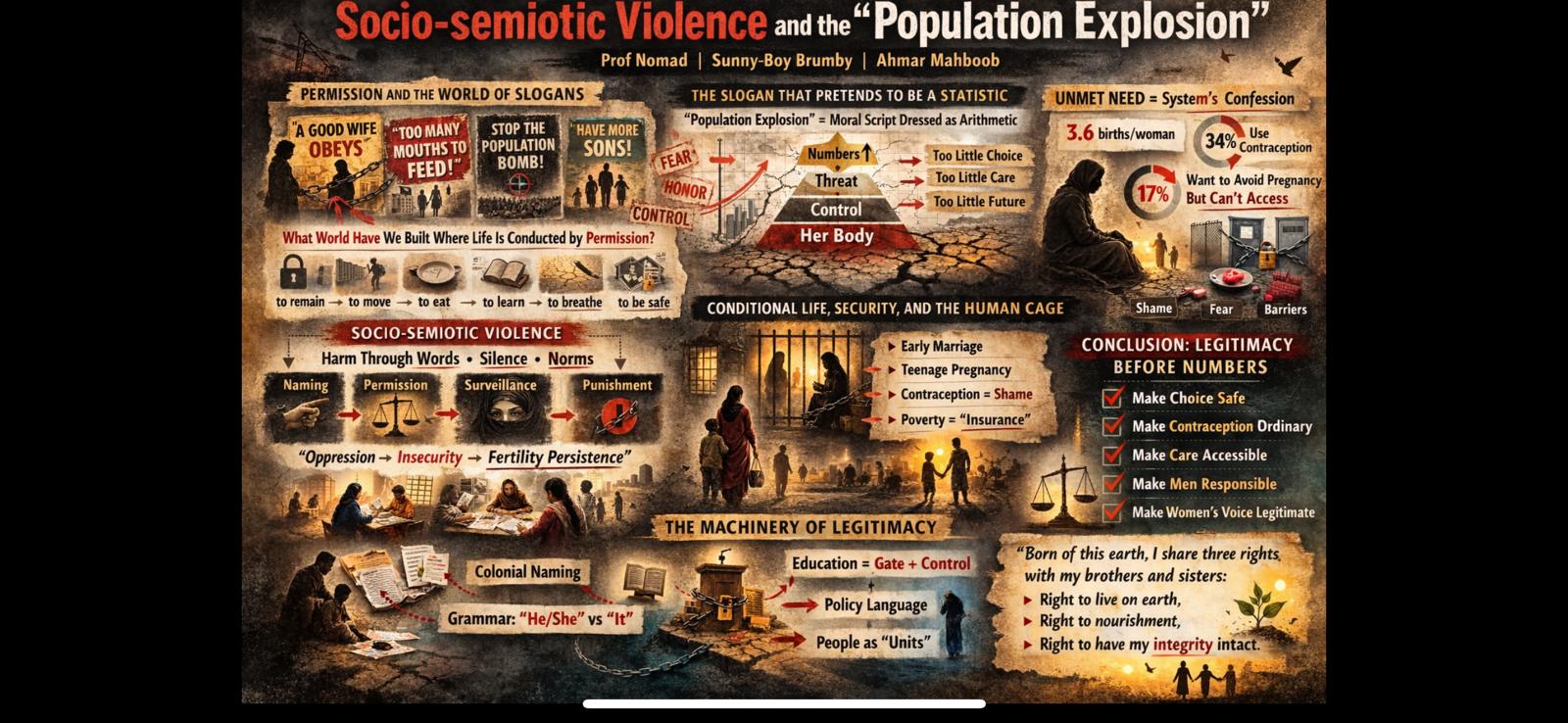
Socio-semiotic Violence and the “Population Explosion”
Prof Nomad I Sunny-Boy Brumby I Ahmar Mahboob
Permission and the World of Slogans
I remember texts with slogans from my childhood. Not poems. Not prayers. Slogans. They told us what a “good” family looked like. They told us what a “good” woman looked and sounded like. They told us what a “good” child owed the nation. We learned early that bodies are not just bodies. They are messages. They are borders. They are contested territory: mapped not by geography, but by meaning.
Those texts did not only instruct. They licensed. They distributed permission.
And permission, once you notice it, is everywhere. What world have we built where life is conducted by permission—permission to remain, permission to move, permission to eat, permission to breathe clean air, permission to learn, to rest, to be safe?
Nature is fraught with predation and scarcity, but it lacks this singular human invention: a system that renders basic existence conditional, revocable, punishable—where dignity can begin to feel like a renewable subscription.
When a life is trained to experience itself as conditional, it adapts. A controlled life becomes a coded life. A surveilled life learns to whisper. This is where we must begin the population question—not with shame, panic, or arithmetic as morality, but with an observation: constraint generates its own logic.
In what follows, I argue that the so-called “population explosion” is best understood as the visible outcome of invisible permissions: who can choose, who can refuse, who can move, who can speak, who can access care without paying with shame.
The Slogan That Pretends to Be a Statistic
So here is the first correction we must make: “population explosion” is itself a slogan. It is a phrase that arrives already armed, a moral script dressed as arithmetic. It points at “numbers” while hiding the hands that build the conditions under which numbers rise. It frames births as a threat-object and care as an afterthought.
It typically conjures one of two images: too many people, or too many poor people. What it often truly signals is: too little safe choice, too little normalized care, too little believable future. A crisis not of abundance, but of constraint.
Consider Pakistan. Census figures and public conversation routinely trigger alarm as the default response. But these numbers are not a moral failure. They are a mirror held up to a society. They reflect the conditions that have been built—and, more importantly, the conditions that have been refused.
Let’s state the argument plainly: oppression engineers the environment through which high fertility persists. These conditions are not mystical; they are measurable. They are lived daily. And they are often enforced not by the barrel of a gun, but by the weight of a word, the silence of a room, the sharp edge of a norm.
Unmet Need and Socio-semiotic Violence
This is what I call socio-semiotic violence: harm delivered through categories, sanctioned silences, and public moral scripts—through what can be said and what cannot, what is “respectable” and what becomes “shame.” It is a violence present in a quiet room. Especially in a quiet room.
Not all violence bruises. Some violence organizes. Some violence names. Some violence assigns roles and calls them “nature.” Some violence builds a cage and teaches you to thank it for keeping you safe.
The data provides the skeleton of this story. The Pakistan Demographic and Health Survey (2017–18) reports a fertility rate of 3.6 births per woman. About 34% of married women use any contraception, with modern methods used by about 25%. Most telling is the statistic of “unmet need”: roughly 17% of married women wish to delay or avoid pregnancy but are not using contraception.
“Unmet need” is the crucial phrase. It is the system’s confession.
It does not mean “they don’t know.”
It does not mean “they don’t care.”
It means: they want something but cannot obtain it safely, consistently, or legitimately.
Therefore, any honest conversation must begin not with blame, but with forensic questions: What blocks choice? What punishes it? What makes choice expensive—socially, morally, physically? And then, because we are adults and not children repeating slogans: who benefits when choice is unsafe? Who gains when a woman’s body remains negotiable property?
Socio-semiotic violence becomes visible in scenes etched into memory. Picture a community health worker sitting on a charpai, notebook on her lap. She does not say “contraception” first. She says “spacing.” She says “health.” She says “rest.” Because the word “planning” can sound like a foreign agenda. “Condom” can sound like a confession. “Pill” can turn a neighbor into a witness. In such conditions, language becomes tactical—people talk around the thing, because naming it can trigger punishment. The conversation often halts with a definitive, quiet verdict: “Allah provides. These things spoil women.”
We must be careful here: this is not a story about religion as the master key. Religion matters profoundly as a meaning-system, but it never acts alone. It arrives braided with schooling, economics, patriarchy, law, class, and state infrastructure. Any interpretive framework—religious, cultural, nationalist, bureaucratic—can be recruited into a system of permission and prohibition. When someone says, “God provides,” we should not rush to mock belief. We must ask what belief is being made to do in that moment. Comfort? Discipline? Protection? Control? Often, it is power speaking through a voice that is treated as eternal.
This returns us to permission. Permission is a semiotic object, built from words, fear, honor, gossip, and surveillance. It is not only taught through textbooks. It is inscribed on the body itself—dictating where it can go, what it can ask for, what it can refuse, and what it must, inevitably, carry.
Some might simplify socio-semiotic violence to stress on an individual. If we interpret “stress” as individual stress, the explanation fails—such stress often impedes fertility. But if we mean structural insecurity—the unrelenting pressure of constrained agency, limited access, and moral policing—then the link becomes clear. Oppression generates this deep insecurity, and that insecurity sustains high fertility. This is a mediated causality: oppression builds the cage; the cage shapes the life within.
Conditional Life, Security, and the Human Cage
The bars of that cage are visible: girls leaving school early; early marriage; teenage pregnancies; distant or judgmental clinics; contraception shrouded in shame; decisions mediated by husbands and mothers-in-law; the looming threat of social or physical violence; and a poverty that makes children a form of essential insurance.
This cage is not only personal or familial; it is built into the very architecture of our systems. Consider: does any other species pay rent to exist? Not in the ecological sense of labor—hunting, foraging, building—but in the transfer of currency for the right to occupy space. With contracts, deadlines, eviction notices.
Does any other life-form purchase its sustenance from a supermarket, buy water in plastic, pay repeatedly for warmth, cleanliness, safety, legality, approval?
Does any other being routinely surrender its young and a significant portion of its wealth to strangers, saying: raise them for me?
I can’t think of one—other than humans.
We do these things not because we are ‘advanced’ or ‘developed’, but because our systems have made basic life conditional. When life is conditional, people build security as they can—through land, networks, migration. And sometimes—often painfully—through children. And then the “experts” arrive and call this a population explosion.
Naming, Grammar, Education: The Machinery of Legitimacy
We observe that governance is not only force; it is vocabulary. It names the world—through the categories it adopts, the taxonomies it repeats, and the language in which it writes its laws.
In my work on colonial knowledge-making, I argue that European empires didn’t only steal land; they introduced categories that restructured social perception. By classifying people into fixed “religions” through bureaucratic templates, colonial systems sowed long-term social division. The key mechanism was not theology. It was naming. It was the decision to turn living practice into a fixed label—a logic called nominalisation.
Once you can name something, you can compare it; once you can compare it, you can rank it; once you can rank it, you can govern it. And once you can govern it, you can punish it.
Now watch what happens when we bring that lens to “population explosion.” “Explosion” makes fertility sound like a bomb. It turns births into a threat-object. It invites control, not care.
This matters because language is not only a mirror of reality; it is part of reality’s machinery. Deep semantics—what Halliday called cryptogrammar—works as a syndrome of patterned meanings that shapes perception and action. When policy language turns people into “targets,” children into “burdens,” and communities into “units,” it becomes easier to treat life as manageable matter rather than negotiated dignity.
Language can enable and enact socio-semiotic violence through a number of linguistic systems, including grammar. English, for example, hard-codes a division between humans and everything else through pronouns: he/she for humans, it for “everything else.” We learn, quietly, that the non-human world is grammatically an object. This feeds the wider habit of treating land, water, forests—and sometimes people—as “resources,” as “units,” as it.
In contrast, some South Asian linguistic systems do not build “humanness” as a grammatical superiority marker in the same way. This doesn’t magically make societies just. But it reminds us that grammar is not innocent, and neither are the categories that come bundled with dominant languages of policy and power.
If the world we govern is the world we can name, then the struggle over fertility is also a struggle over who gets to name a woman’s body—and in what language, and with what legitimacy.
It is no accident that the most controlling scripts often arrive as “education.” When literacy becomes not a tool but a belief-system, a gate, a tribunal, it becomes another arm of socio-semiotic violence. Access to reproductive health is not only about clinics; it is about the literacies of navigation: who can read the forms, who can speak to a male doctor without shame, who can return home without being interrogated.
Conclusion: Legitimacy Before Numbers
So what, then, is a “population explosion” in its essence?
It is not a bomb.
It is not a cultural habit.
It is not a national character flaw.
It is the visible, statistical outcome of invisible, daily constraints. A population “explodes” when the future feels blocked, when education is fragile, when care is unreliable, when a woman’s autonomy is a tense negotiation, when contraception is a moral hazard, when a small family is viewed with suspicion, when “choice” exists on paper but not in lived safety.
In short: when choice is unsafe, births become the default.
They say: control the population.
They mean: control her.
They say: our culture.
They mean: our hierarchy.
They say: morality.
They mean: permission.
And she is left holding a body that must obey rules it never voted for—rules whispered as love, rules enforced as fear.
If we seek meaningful change, we cannot start with numbers. We must start with legitimacy. The most practical claim is this: reduce socio-semiotic violence, and you dismantle the architecture that sustains high fertility.
Make spacing speakable.
Make contraception ordinary.
Make clinics reliable.
Make men responsible, not just proud.
Make the story of a “good woman” expansive enough to include her own knowledge.
Make “family planning” sound like care—not betrayal.
Because the conversation about population is never just about numbers. It is, fundamentally, about who is allowed to author a life. And until that question is answered with justice, the numbers will continue their relentless climb—not because people desire too many children, but because the world they inhabit offers too few safe exits from the script written on the wall — and repeated in our textbooks, headlines, and policies.
Born of this earth, I share three rights
with my brothers and sisters
who crawl, fly, swim, stand, or whatever:
Right to live on earth;
Right to nourishment;
Right to receive your integrity;
These fulfilled, Mother Earth will keep me strong.

